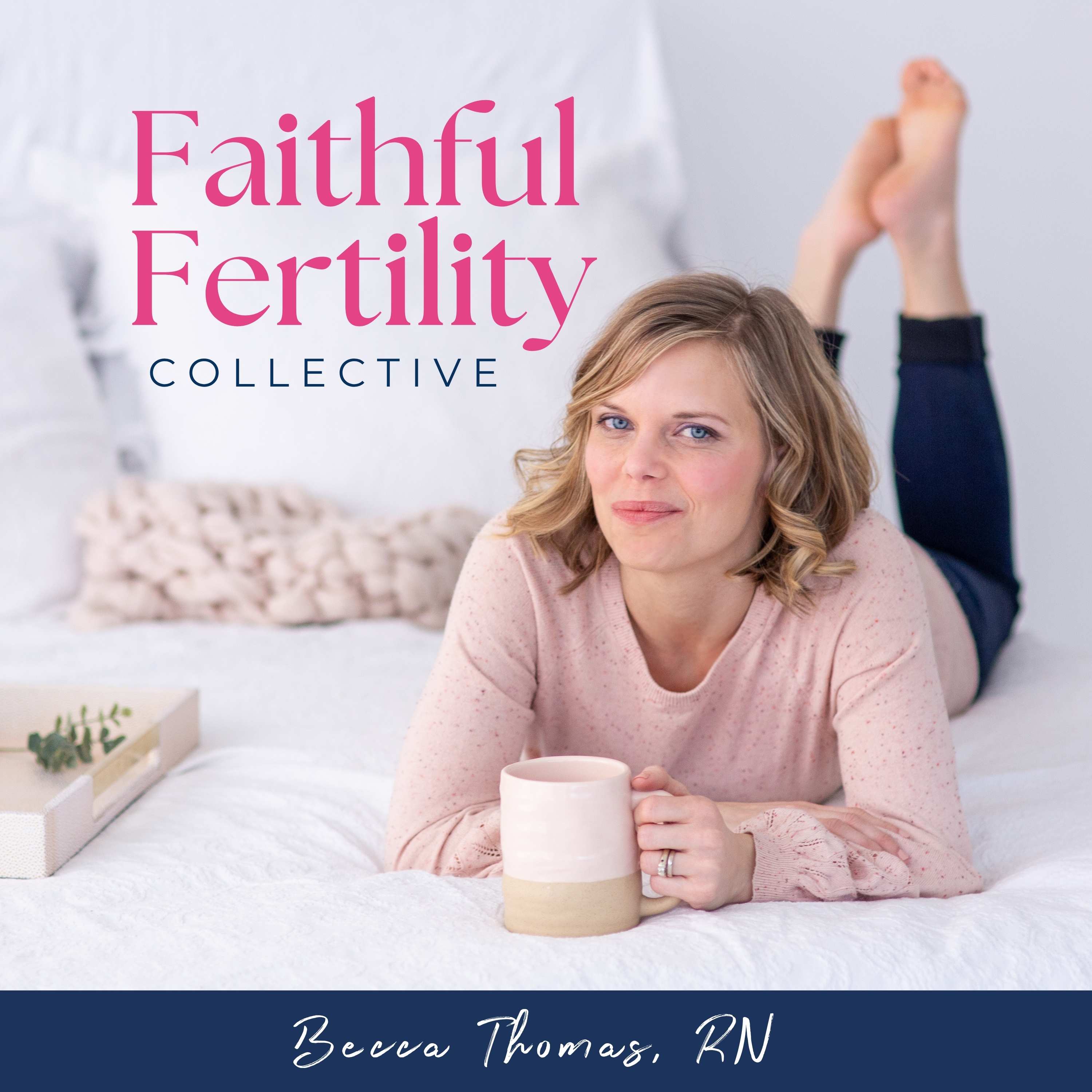
1 • From Nursing to Nutrition: My Faithful Fertility Journey
Faithful Fertility Collective
| Becca Thomas | Rating 0 (0) (0) |
| https://www.faithfulfertilility.co | Launched: Oct 14, 2025 |
| hello@faithfulfertility.co | Season: 1 Episode: 1 |
Welcome to the Faithful Fertility Collective! In this episode, Becca opens up about her personal journey that led her to a deep passion for nutrition and fertility. From her unique background as a homeschooled student influenced by her mother’s intuition for natural health, to her experiences in nursing school, Becca shares how she became aware of the gaps in nutritional education within conventional healthcare. She discusses her eye-opening work with a chiropractor, the challenges she faced navigating vaccine education, and her firsthand encounters with the impacts of nutrition on her own child’s health.
Becca also details her transition from traditional nursing to nutritional therapy, inspired by both her own experiences as a mother and the stories of friends struggling with unexplained infertility. Ultimately, her journey through advocacy, ongoing education, and supporting her first fertility client revealed her calling to help couples address the root causes of infertility naturally. With a foundation rooted in faith, Becca invites you to join her as she shares hope, practical insights, and encouragement for your fertility journey, blending science, personal experience, and spiritual support.
SUBSCRIBE

Episode Chapters
Welcome to the Faithful Fertility Collective! In this episode, Becca opens up about her personal journey that led her to a deep passion for nutrition and fertility. From her unique background as a homeschooled student influenced by her mother’s intuition for natural health, to her experiences in nursing school, Becca shares how she became aware of the gaps in nutritional education within conventional healthcare. She discusses her eye-opening work with a chiropractor, the challenges she faced navigating vaccine education, and her firsthand encounters with the impacts of nutrition on her own child’s health.
Becca also details her transition from traditional nursing to nutritional therapy, inspired by both her own experiences as a mother and the stories of friends struggling with unexplained infertility. Ultimately, her journey through advocacy, ongoing education, and supporting her first fertility client revealed her calling to help couples address the root causes of infertility naturally. With a foundation rooted in faith, Becca invites you to join her as she shares hope, practical insights, and encouragement for your fertility journey, blending science, personal experience, and spiritual support.
Hey there if we are new friends. I just wanted to introduce myself and give you a little background of how I became so passionate about nutrition and specifically fertility. So, interestingly enough, I was homeschooled from, I think sixth grade on I'm one of those awkward homeschooled children if you've never met one.
Hello. And long story short, my mom actually was pretty. It open and interested in natural health, and I talked to her about this a while ago and she just said that it was really intuition from God that led her to be more naturally minded in health. But I remember clearly I. When I was in high school, we were reading this book, and I don't remember what the book is, but she was talking about daily bms and as high school and middle school children.
Of course, we thought that was hilarious and laughing. But little did I know that my mom was onto something and I graduated high school. I did a [00:01:00] year about bible college, and then I came back home. I met my husband, I got married, and then I actually started nursing school the next year and. When I was in nursing school, I worked for a chiropractor, which was such a cool experience because while I was taking anatomy and physiology and.
Microbiology and all these things. He had obviously taken all of these as well, so he was great if I had questions or anything like that. But he actually, during our downtime, taught me a lot about more about natural health and was just kind of a sounding board for some of the things I was learning and comparing.
His chiropractic education to my education and his guidance, along with a lot of the transformations that I saw working in that clinic and through chiropractic. For instance, I remember this mom bringing her little boy in who had had. Ear infection after ear infection after ear infection and had been on three rounds of antibiotics and [00:02:00] still had another ear infection.
And after like two or three adjustments it finally cleared up. So I knew there had to be something to it and just kind of started reading a little bit on my own here and there. Along that, with that, while I was in nursing school, I started having questions like, why do we spend a whole semester learning about drugs, but only three class periods learning about nutrition?
So there was really, a lack of. Knowledge as far as nutrition went, but we learned so much about drugs and of course as nurses, we're giving a lot of medications and we do need to know the classes and the side effects and the things to watch out for. But it just really opened my eyes to the discrepancy of that is the only tool in the toolbox for medical professionals is medications.
Even in those last three class periods of nutrition, it was towards the, the last part of my nursing education that that took place. But even throughout that, it, [00:03:00] it really dawned on me doing clinicals. How poor the food quality was. Like it was all processed canned foods that we were giving these clients.
And if you've been in a hospital or in a long-term care facility, you know that's true that we are giving the sickest of our sick the most poor quality foods that really have zero nutritional value, if anything, or we're giving them even worse. We're giving them soda and donuts and, and pancakes and things like that.
So I just really started to ask why, why we spend so much time on drugs and not really looking into what people are eating. And then my other question was, again, the first semester of nursing school, we learned, we, we all took a class called pharmacology, which is the study of medications, drugs, essentially.
And you learn so much about how drugs are, utilized in the body, how long they stay there, which is called the half-life, things like that. drugs that you need to taper up on, [00:04:00] drugs that you need to taper down on different classes of drugs, things like that. But it kind of dawned on me 'cause I had been peaked, especially working for the chiropractor, that we didn't talk about vaccines at all in this class.
And it was really interesting to me. Why is this product vaccines that's given to every single person, like it's just. Assume that they will get it, and we give them on day one in the US babies get the Hep B, which by the way, like, why are we giving a vaccine for a sexually transmitted disease to babies?
But anyways, that's a, a discussion for another time. But why are we giving this product to every single person? And it's not even touched on in pharmacology. And in fact, in nursing school, your textbooks are probably two to three inches thick each semester. You go through a lot of those books, thousands of pages of.
Reading lots and lots of classes and clinicals and discussions and things like that. Out of the thousands and thousands of [00:05:00] pages that we read in nursing school, only about seven of those pages were about vaccines.
And again, why are we getting so little education about this product that is. I mean, in some states mandated for every single child that's going to school. Um, and some employers are mandating things like this. And of course we saw this during COVID as well, and I have my own story that I'll share in a little bit.
But even though seven pages were mostly dedicated to the childhood vaccine schedule. And it just really made me think back to pharmacology class. 'cause this wasn't until about the last semester of nursing school, but it really made, made me think back to pharmacology class when one of the things they drilled into us was, when you're giving a medication, there's always risk.
So we have to, as healthcare practitioners decide, does the benefit outweigh the risk? And so [00:06:00] one time in. In class when we were discussing this, I raised my hand and I asked the teacher, because with children we, we don't know that the benefits outweigh the risk. At least I don't think we do. But anyways, I raised my hand and I asked, you know, how do we know that when we're giving these, that the benefit outweighs the risk?
And she pointed her finger. Right at me kind of in my face and said, when it comes to vaccines, the benefits always outweigh the risks. And that was like end of discussion. And we weren't taught how to identify. Any type of reaction besides like a severe anaphylactic reaction? the VES system, which is the Vaccine Adverse Event Reporting System.
If you're not familiar with that, it was mentioned briefly, but none of my time in school or clinicals or anything, nobody, showed us how to use this at all. So anyways, long story short, I graduated, took my boards, I had my baby, and I started my first like [00:07:00] actual RN job. All within, I think it was three or four months of each other that year.
I actually started in dialysis, which is atypical. Most people start in something like med surg, but I had volunteered within the unit, so I was able to get my foot in there when they had an opening. And it was just really interesting because. Again, I had had my first baby shortly after nursing school, and she had eczema, and interestingly enough, I had chosen her pediatrician very carefully because I knew that I had some hesitations about vaccines at this point and didn't want to be forced, shamed into that.
Um, I had another experience with a doctor, actually with my mother-in-law where she was very shamed. For refusing a flu shot, and I just knew I didn't wanna be dealing with that when I was working with, with the pediatrician, so I chose based on that, I did some interviewing. Anyways, at about six months old, my [00:08:00] baby developed eczema and it was something that I kind of, sort of knew a little bit about, but not really.
And when I took her in to be seen, my practitioner told me, and of course this was 15 years ago now, she told me that there was new research coming out that showed that probiotics could actually be beneficial for eczema. And this is before probiotics were in every single product you see on the shelf now.
This was new research. And interestingly enough, I went to work and I asked the doctor what he thought about this, because being fresh outta nursing school and learning about steroid creams and stuff, I knew I didn't wanna slather that on my newborn.
Ever wonder what's actually standing between you and pregnancy? It might not be what you think. Hidden nutritional imbalances and heavy metal toxicity could be blocking your fertility for both of you. That's why I created the Fertility Foundations test for couples.
This test can show where your body is struggling and why. so you can stop guessing and start addressing the [00:09:00] real root causes. Head to the show notes. Or faithful fertility.co/fertility foundations to order your test today and finally get the answers you've been searching for.
And so I asked him, you know, have you heard this? What do you think of it?
And he literally laughed at my face and said, the gut has nothing to do with the skin. Well, long story short, I chose the probiotics over that, and I also ended up taking my daughter to see a nutritionist, and she did see some improvement in her eczema. And at that point I was like, oh, there's gotta be something to this.
And along with that, I had a client, when you're in dialysis, your clients are there. Either two or three days a week for anywhere from two to five hours at a time. So you get to know them really well. And one of my clients, her name was gda, but she had told me, she asked me if I'd ever heard of the West Nate Price Foundation, which I hadn't at that point.
So of course, being a new mom and very, being very research, um, oriented and, [00:10:00] you know, knowing how to look for things, being fresh outta nursing school or whatever. I looked up the West Nate Price Foundation, which led me to. Paleo. 'cause paleo was kind of an emerging movement at that time and it just kind of opened my eyes to everything going on and how healthcare was really overlooking all of the, like the nutritional components in favor of drugs and surgeries.
And not to say that tho those aren't necessary sometimes, but in our culture, they are here in the us, in our culture, they are the go-to rather than the last resort. So I saw some improvement in my daughter and started reading voraciously on my own more about this 'cause I was very intrigued. And then in 2012, in January of 2012, I was actually fired for refusing a flu shot.
I had requested a religious exemption, which was denied. Um, and they fired me in January of 2012. And I actually [00:11:00] did file a complaint with the EOC because that is the religious discrimination and I won. But all that to say, at that point I knew that I wanted to help people, but healthcare wasn't it. So I worked a few more nursing jobs here and there, but in 2015 I was so intrigued by nutrition.
I was like, I need to learn more about this and get like formal education in it. And I ended up going, getting a certification in nutritional therapy. And then I, at that point I had my third child. But during this time, looking back. When I was in nursing school, I actually had three different friends that were dealing with fertility and they've all gone on to have babies since then.
But it was just really intriguing to me that these young, healthy women, like none of them had any, disease diagnosis. They weren't overweight or, you know, just what would be described as young, healthy women and couldn't get pregnant [00:12:00] and. I started my practice in 2015 just doing nutrition, kind of here and there for whoever.
I had three young kids at home and my husband traveled, so it was definitely more of a hobby than a job. But in 2020, I had someone reach out to me and she's like, I know that you do some consulting with women who are pregnant, but do you think you could help me get pregnant? And I was like, I don't know, but we'll try and so that was my first fertility client.
In February or March of 2020, she came on. And we went through a three stage process. I didn't even do any testing at that point. I was doing a nutritional assessment and uh, obviously custom supplementation. And then we did a detox. And long story short, she was pregnant within four months. And not only that, but she was dealing with debilitating anxiety and she was seeing a counselor and told me when we started working together.
She told me that she didn't wanna go on meds, but that she was at the point that she felt that she would need to, [00:13:00] and she since opened up to me and told me she thought she was dealing with postpartum depression. 'cause this was secondary infertility for her, but it was just really interesting how, just tweaking a few things.
Not only was she pregnant within four months, but then she also, her anxiety she said was 90% better. So. I was really passionate about helping moms in pregnancy because I wanted the next generation to be healthier. But the more I looked, the more I saw that not only was infertility a big problem, but if I wanted to really help the next generation, the best way to do that was before people actually got pregnant and teaching them how to nourish their bodies well before they even get to the point of pregnancy.
Since then, I've really been focused on fertility and really gotten to the point where I work with both men and women. Because in fertility statistics usually about 30% it the man is the cause of factor. 30% is the women and 30%, both of [00:14:00] them are a contributing factor to the fertility issues.
But it's one of those things that. Looking back now, even though it was not an easy road, how God just uses our messes to become our message. And I'm here to tell you that there is hope for your fertility journey. There is hope for getting pregnant naturally, and there's a lot that both you and your husband can do to get your bodies on track.
And in fact, a lot of ancient cultures. They had a three to six month window of preparation for fertility, and there's one culture that had their couples get married at a certain time of year because they knew that was when the grass was most like young, fresh grass would be most nourishing for cow's milk and they would feed their.
They're young couples, they're married couples that fresh spring cow's milk because it was rich [00:15:00] in vitamin D and vitamin A and healthy fats and things like that. And our culture has really gotten away from that. And I would say even as a Christian, that if you grew up anywhere near purity culture or had some reverberations of that, if you're a bit younger, but.
We were, we kind of just expected that the first time we had sex we would be pregnant. And so if you are a Christian woman and really struggling with this, I wanna know that that's a very normal thing that I hear. And especially that purity culture set that expectation up. And I'm sorry that that is not true in any way, shape or form.
And in fact, most of us, whether Christian or not, know very little about our bodies and how our bodies work and. The truth is that there's only about six days a month that a woman can get pregnant, but a man is fertile all the time. And we're gonna talk about how the onus of both birth control and pregnancy fall on the woman.
But [00:16:00] it's just, it really is unfortunate that our, our culture and our society has put the onus on women. But men are such a big part of a fertility and obviously birth control because they are fertile every time they ejaculate. If they have good sperm numbers where women are only fertile about six. Days outta the month.
So anyways, long story short, that's where I come from and that is my background. I do wanna let you know that I do love Jesus. and he is, that is the focus of my business because when you go through difficult times. It either makes or breaks your faith, and I wanna be here to help support you, not just in your fertility, but also in your marriage and your faith.
So if that sounds something that aligns with what, where you're at and what you believe, then I invite you to listen along. I'm gonna be giving lots of information about natural fertility, about the, the testing that I do with couples so that you can learn and glean all of the [00:17:00] amazing things that I've learned over the years.
That will help you to get pregnant naturally.